

Schizophrenia
Schizophrenia is a serious mental disorder that affects thinking, emotional life, motivation, and daily functioning. In addition to the more well-known positive symptoms such as hallucinations and delusions, many patients also experience so-called negative symptoms. These include, among others, loss of initiative, reduced emotional responsiveness, social withdrawal, low energy, and cognitive difficulties.
Negative symptoms are often long-lasting and have a major impact on functioning and quality of life. At the same time, they are generally difficult to treat, as they respond only to a limited extent to antipsychotic medication. Research suggests that negative symptoms are associated with reduced activity in prefrontal brain regions, which are central to motivation, planning, and emotional regulation.
This reduced prefrontal activity can make it harder for the brain to initiate actions, regulate emotions, and maintain social contact—even when positive symptoms are well controlled.
Treatment of schizophrenia with rTMS – focus on negative symptoms
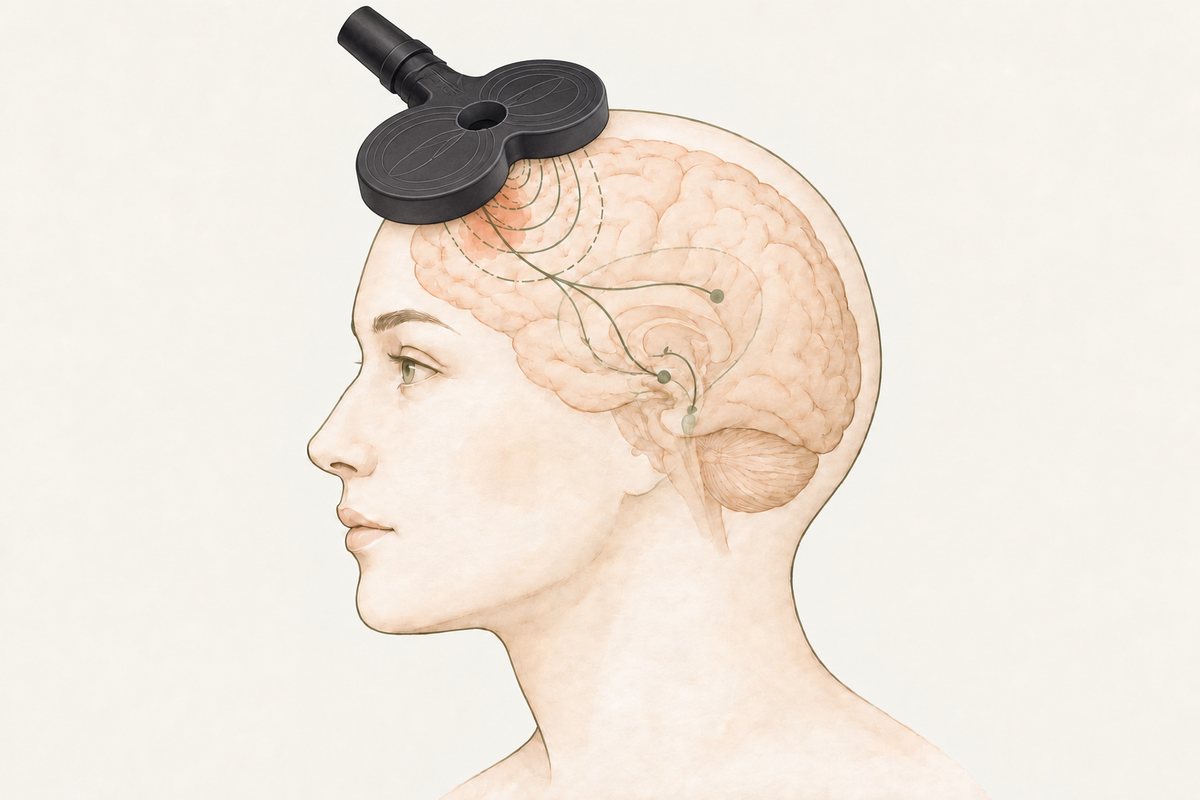
In schizophrenia, rTMS is primarily used with the aim of reducing negative symptoms. The treatment targets prefrontal brain regions that are often underactive in patients with pronounced negative symptoms.
Repeated stimulation over several weeks can increase activity in these areas and contribute to more adaptive regulation of networks involved in motivation, initiative, and emotional responsiveness. The treatment is not intended to replace antipsychotic medication, but is used as a supplement in selected patients.
Treatment takes place at the clinic. You remain awake throughout the session and can go home afterwards. The stimulation itself lasts no more than 20 minutes, and we set aside at least 45 minutes for each appointment to allow time for preparation and a short conversation. A treatment course often extends over several weeks.
Effect and expectations
Studies show that rTMS can reduce negative symptoms in some patients with schizophrenia. Improvements are typically seen as increased energy, better initiative, greater emotional presence, and improved ability to engage in daily activities and social interaction.
The effect develops gradually over time and is related to neuroplasticity—the brain’s ability to change its function through repeated stimulation. It is important to be realistic: rTMS does not work for everyone, and the effect varies. In some, improvement is clear; in others, more modest; and some experience no significant change.
Side effects are usually mild and transient. The most common are mild headache or discomfort during stimulation, particularly at the beginning of the course.
Compared with other treatment approaches for schizophrenia
Treatment of schizophrenia typically consists of:
-
Antipsychotic medication
-
Psychosocial support and rehabilitation
-
Psychotherapeutic and cognitive interventions
-
Social support and structured daily-life programmes
| Antipsychotic medication | Talk therapy | rTMS | |
|---|---|---|---|
| How it works | You take medication daily, often for a long time | Sessions with a psychologist, e.g. cognitive therapy | You sit in a chair with a coil over your head for no more than 20 minutes and go home afterwards |
| Duration | Often long-term, typically several years | Often several months | Over in 4-6 weeks |
| Side effects | Can be considerable, e.g. weight gain and fatigue | No physical side effects, but can be emotionally demanding | Few and mild, pass quickly |
| When is it chosen? | Core treatment for schizophrenia | As a supplement to medication | As a supplement to medication, especially for negative symptoms that have not improved enough. Always after individual assessment |
While medication is often effective for positive symptoms, treatment options for negative symptoms are limited. rTMS differs in that it directly targets the brain regions involved in negative symptoms and may, in selected patients, be a relevant supplement to existing treatment.
Scientific literature
- Review of the safety of rTMS for people with schizophrenia: Safety of rTMS for Schizophrenia: A Systematic Review and Meta-analysis (Blyth et al., 2024) – “rTMS is safe and well tolerated for people with schizophrenia. Individuals with schizophrenia are not at increased risk for adverse effects, including seizure, compared to the general population.”
- Systematic review of the effect of rTMS on negative symptoms in schizophrenia: Efficacy of repetitive transcranial magnetic stimulation (rTMS) on negative symptoms and cognitive functioning in schizophrenia: An umbrella review of systematic reviews and meta-analyses (Yi et al., 2024) – “We suggest rTMS treatment as an adjuvant therapy for treating negative symptoms and cognitive dysfunction in schizophrenic patients who are poorly responsive to pharmacotherapy or who have early-stage schizophrenia”
- Danish systematic review of the effect of rTMS on negative symptoms in schizophrenia: The efficacy of transcranial magnetic stimulation (TMS) for negative symptoms in schizophrenia: a systematic review and meta-analysis (Lorentzen et al., 2022): “In conclusion, this systematic review and meta-analysis of data from sham-controlled studies suggests that TMS is efficacious in the treatment of negative symptoms of schizophrenia.”
Is rTMS right for you?
Book a free, no-obligation initial consultation, and we will assess it together.