News
International Trial: More Than Twice as Many People With Fibromyalgia Had Their Pain Halved With rTMS as With Placebo
An international trial of 101 women with fibromyalgia, whose previous treatment had not helped enough, tested rTMS as an add-on to their usual care. Participants were randomly assigned to rTMS or placebo treatment, and neither participants nor researchers knew who received which. The programme lasted 16 weeks.
After eight weeks, about 4 in 10 in the rTMS group had their pain cut in half, compared with fewer than 2 in 10 in the placebo group. Pain relief faded towards week 16, while the improvement in everyday functioning persisted. There were no serious side effects. The most common were headache, neck pain and drowsiness, and they occurred equally often in both groups.
The authors point out that only women took part, and that it is unknown how long the effect lasts after treatment ends.
Ugeskrift for Læger: Low-Frequency rTMS May Play a Larger Role in the Treatment of Depression
A recent review article published in the Danish Medical Journal (Ugeskrift for Læger) summarizes the current evidence on low-frequency repetitive transcranial magnetic stimulation (rTMS) for depression.
The article reports that, although supported by a smaller body of evidence, low-frequency rTMS applied to the right prefrontal cortex appears to have an antidepressant effect comparable to that of high-frequency rTMS applied to the left prefrontal cortex.
The authors also highlight the favourable safety and side-effect profile of low-frequency rTMS. They conclude that it has the potential to play a larger role in the treatment of depression in the future, while emphasizing that further research is still needed.
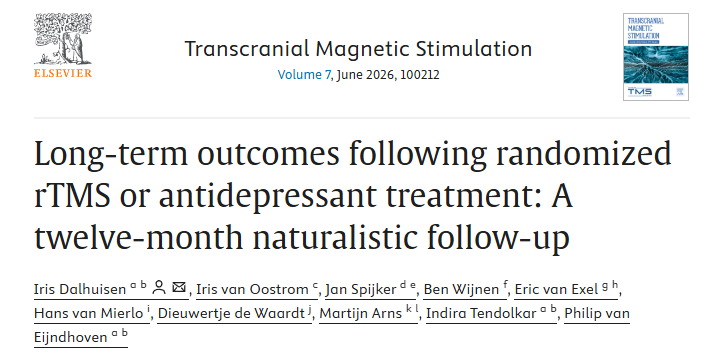
Dutch Study: The Effects of rTMS for Depression Remained Stable Over 12 Months
A new Dutch study investigated how long the effects of repetitive transcranial magnetic stimulation (rTMS) may last in people with treatment-resistant depression—one of the most challenging forms of depression to treat.
After eight weeks of treatment, approximately 4 in 10 patients who received rTMS experienced a meaningful improvement in their depressive symptoms. Nearly 3 in 10 had so few remaining symptoms that they were considered to be in remission.
The researchers followed participants for up to 12 months. Among those who had received rTMS, the overall treatment effect remained stable throughout the follow-up period. The findings suggest that, for some patients, the benefits of rTMS can persist long after the initial course of treatment has ended.
Journal of the Norwegian Medical Association: rTMS for Depression – A Treatment That Is Here to Stay
In a recent article published in the Journal of the Norwegian Medical Association (Tidsskrift for Den norske legeforening), Norwegian researchers highlight transcranial magnetic stimulation (TMS/rTMS) as a well-established treatment for depression.
The authors point to international clinical trials and meta-analyses demonstrating the effectiveness of rTMS and argue that the treatment should be made available to a greater number of patients. They emphasize that people who have not achieved sufficient improvement with medication or psychotherapy may particularly benefit from rTMS.
Source: Hirnstein & Oltedal, Transcranial magnetic stimulation – here to stay, 2025.