

Obsessive-compulsive-disorder (OCD)
OCD is a mental disorder characterised by persistent obsessions and repetitive compulsive behaviours that are experienced as difficult to control and are often associated with significant anxiety and distress. In severe cases, the condition can dominate daily life and lead to markedly reduced functioning.
From a neurobiological perspective, OCD is associated with altered activity in specific brain circuits, particularly the so-called fronto–striato–thalamic networks. These circuits are involved in impulse regulation, habit formation, error signalling, and cognitive flexibility. In OCD, these circuits are often overactive, which contributes to the brain becoming locked into repetitive thought patterns and behaviours.
In practice, this dysregulation means that the brain has difficulty “letting go” of obsessions and stopping compulsions—even when the individual is intellectually aware that the thoughts and behaviours are excessive or maladaptive.
Treatment of OCD with rTMS – how it works and what to expect
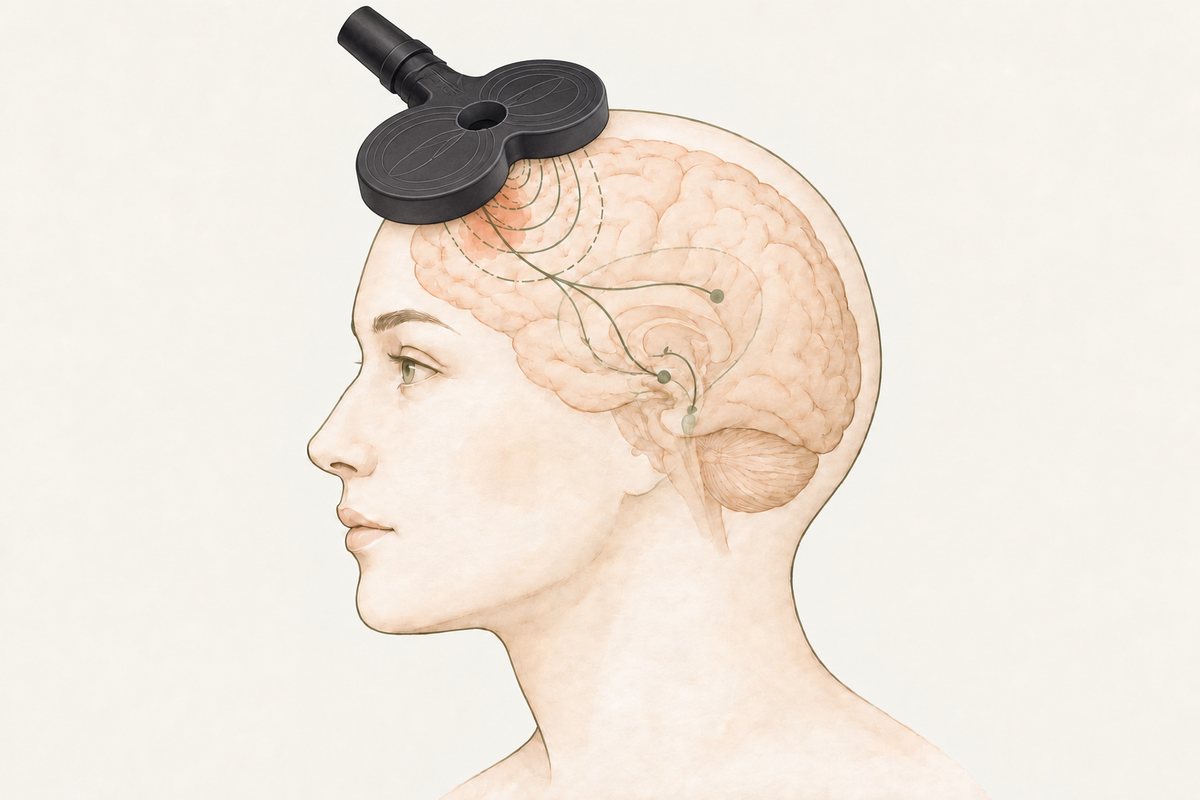
rTMS is used in OCD with the aim of influencing the brain circuits involved in compulsive and repetitive behaviour. The treatment targets frontal brain regions that play a central role in impulse regulation, cognitive control, and emotional processing.
Repeated stimulation over several weeks can alter activity in these circuits and contribute to a more flexible and adaptive regulation of obsessions and compulsions. rTMS is typically used as a supplement to existing treatment, especially in patients for whom medication and cognitive behavioural therapy have not had sufficient effect.
Treatment takes place at the clinic. You remain awake throughout the session and can go home afterwards. The stimulation itself lasts no more than 20 minutes, and we set aside at least 45 minutes for each appointment to allow time for preparation and a short conversation. A treatment course often extends over several weeks.
Effect and expectations
Studies show that rTMS can reduce the severity of OCD symptoms in a proportion of patients. Improvements are often seen as less intrusive obsessions, fewer or less time-consuming compulsions, and an improved ability to resist the urge to repeat behaviours.
The effect develops gradually over time and is related to neuroplasticity—the brain’s ability to change activity and connectivity through repeated stimulation. rTMS does not work for everyone. Some experience clear symptom relief, others a more modest effect, and some experience no significant improvement. Realistic expectation-setting is therefore important.
Side effects are generally mild and transient. The most common are mild headache or discomfort during stimulation, especially at the beginning of the treatment course.
Compared with other treatment approaches for OCD
OCD is typically treated with:
-
Cognitive behavioural therapy with exposure and response prevention
-
Pharmacological treatment, often with high-dose SSRIs
-
A combination of psychotherapy and medication
| Medication (SSRI) | Talk therapy with exposure | rTMS | |
|---|---|---|---|
| How it works | You take a tablet every day, often at a high dose | Sessions and exercises with a psychologist, typically weekly | You sit in a chair with a coil over your head for no more than 20 minutes and go home afterwards |
| Duration | Typically at least 12 months | Often several months | 10 sessions over 2 weeks, then 1-2 per week as maintenance |
| Side effects | Vary and can be considerable | No physical side effects, but exposure can be demanding | Few and mild, pass quickly |
| When is it chosen? | First choice, often combined with therapy | First choice | When medication and therapy have not helped enough, or if you do not want medication. Always after individual assessment |
Many benefit from these treatments, but not everyone. In patients with persistent or severe OCD, rTMS may be a relevant supplement, particularly when standard treatments have not provided sufficient benefit.
Scientific literature
- Systematic review of the effect of rTMS on OCD: Repetitive transcranial magnetic stimulation for obsessive-compulsive disorder: A systematic review and pairwise/network meta-analysis (Fitzsimmons et al., 2022). – “…rTMS for OCD was efficacious compared with sham stimulation”
- Randomised controlled study of the effect of rTMS on OCD symptoms: rTMS investigation of resistant Obsessive-Compulsive Related Disorders: Efficacy of targeting the reward system (Ponzio et al., 2023) – “Analysis of the results showed a reduction in symptom severity at the end of the treatment in all three groups (p < 0.0001) as well as a reduction in depression symptoms (p < 0.01).”
- Survey of how health services in different countries use rTMS to treat OCD: An international survey of different transcranial magnetic stimulation (TMS) protocols for patients with obsessive-compulsive disorder (OCD) (Brakoulias et al. 2021) – “TMS is used for OCD around the world but the mode of delivery varies significantly between sites.”
Is rTMS right for you?
Book a free, no-obligation initial consultation, and we will assess it together.